
| Home > History of the 43rd Bomb Group |
|
|
||
| K e n s m e n : 4 3 r d B o m b G r o u p (H), 5 t h A A F | ||
|
| Unit
History There is still some debate as to the origins of the moniker. One version is that Ken's Men were named for the tremendous pilot, Capt. Ken McCullar of the 63rd Bomb Squadron, who, along with then 1st Lt. James T. Murphy, Major Benn, 1st Lt. Folmer "The Swede" Sogaard, Glenn Lewis and others, helped perfect the technique of "skip bombing". On page 29 of his book "The Forgotten Fifth" , Michael John Claringbould writes that on 12 April, 1943 McCullar's B-17 " 'Blues in the Night' hit a wallaby during a night take-off from Seven-mile, killing Group Commander Ken McCullar" and all crewmates (from the 64th SQ): Byron Q. Andrew, Blaine McCord, Jr., John W. Schultz, Elmer R. Hansen, Philip A. Zumwalt, Bert F. Breddemeier, George A. Mowad, David W. Stuckey, Pierre R. O'Grady, and Michael J. Paz (of the 63rd SQ). Claringbould has 2 footnotes regarding this. The first tells how the report says the plane hit a kangaroo, but since there are no kangaroos on New Guinea, it had to be a wallaby of which there were plenty in that area of the world (there is a great dispute as to the veracity of either 'official version' of McCullar and crew's deaths. See below in the "Articles" section.) The second footnote says, "Henceforth the Group would term itself 'Ken's Men' in honour of Ken McCullar. There has been argument since as to whether the sobriquet honoured McCullar or General Kenney, but private diary extracts confirm McCullar's honorary status." The other story, as indicated above, and one that is documented both in James T. Murphy's book, "Skip Bombing" and in General Kenney's book, "General Kenney Reports: A Personal History of the Pacific War", is that Ken's Men were named for General George Kenney. From Kenney's book: "Bill Benn came over for a chat.
He said the 43rd
Group wanted to call themselves the Kens Men and did I have any
objection. I told him that I had none and to tell the gang that I felt
highly honored. The next time I inspected the group they had painted
out the cute, scantily clothed girls and substituted the words "Kens
Men" in block letters a foot high. I was flattered, of course, but I
sort of missed the pretty gals."
James Murphy recounts in his book that, while having lunch with General Kenney, he was told by him that he "couldn't have been more proud than when Bill Benn told him that the 43rd Group wanted to call their outfit the 'Kensmen'" after Kenney. (Both Murphy's and Kenny's books can be purchased from this site's bookstore.) The Motto and Isignia The motto of the 43rd BG was "Willing, Able, Ready"---W.A.R. The tails of planes in the 43rd could be identified by the horizontal red and white stripes just at the edges of the rudders, with room before it for each squadron's emblems. (To see each Squadron's insignia and specific tail markings, visit their respective Briefing Rooms accessible from the main page of this site.) The design for the 5th AAF's shoulder patch was approved on 25 March, 1943. The stars in the design are in the pattern of the Southern Cross, where the Fifth did their fighting. The comet motif was taken from this AF's former aircraft markings; the three tails of the comet are said to symbolize fighters, bombers, and troop carriers.  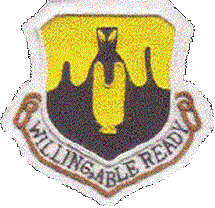 Beginnings
Before the start of WWII, the 43rd Bombardment Group, constituted on 20 November, 1940 and consisting of the 63rd, 64th, and 65th Squadrons and with the 13th Reconnaissance Squadron as an attached unit, was a part of the 1st Air Force. Activated on 15 January, 1941 at Langley Field, Virginia, it began the war flying B-17 ASW patrols from Pope Field, North Carolina and MacDill Field, Florida. It wasn't until Friday, 27 February, 1942 that the 13th Reconnaissance Squadron --later designated the 403rd Squadron-- arrived at Melbourne, Australia with B-17's. The other squadrons followed, the 64th Squadron arriving in Sydney, Australia on Sunday, 15 March, 1942 and the 63rd and 65th Squadrons arriving on Saturday, 28 March, 1942, both equipped with B-17s. Thus began the legend of Ken's Men. They became a group of heroes who earned the following honors: Southwest Pacific Area (23 July, 1942 - 23 January, 1943); Battle of the Bismarck Sea (2, 3, 4 March, 1943); Huon Peninsula Campaign (November, 1943 - March, 1944); The Army Air Force in World War II; The Philippines Presidential Citation. They were men among whose ranks were two recipients of the Medal of Honor -- awarded to Captain Jay Zeamer and Lieutenant Joseph R. Sarnoski (see below for their story). They were men without whom the Japanese stronghold in the Pacific would have remained just that. They are men to whom America owes a great deal of gratitude for their sacrifice. I know they have mine. Articles, Audio, Video, and Miscellaneous Pictures
Maps
Poetry and Song from the 43rd
|
|

